
OVER TESTING LEADS TO UNDER TEACHING

000620-0007-000007

So now Year Ones are to have a new test to determine who has problems.

By this time of the year Grade One teachers have already identified these youngsters and doing all they can to help them catch-up and have success with basic literacy and numeracy skills.

The money to develop this new test could be used to put extra teacher assistants in the classrooms and purchase adequate teaching resources. (Teachers buy their own!)

Australian kids are over-tested and under-taught!

There are problems that results from this over-testing:

  • Parents naturally worry about the tests and are concerned the results will affect their children’s futures. According to parents, judgements about who can enter certain private schools are sometimes made using NAPLAN results.
  • MANY schools are holding time-consuming NAPLAN coaching sessions for entire classes and teachers who attend our professional development sessions are concerned about this.
  • Every time teachers coach kids to pass a test they are not teaching to the needs of their classes.
  • Students are really worried- we have so many year 3 children who are really frightened of NAPLAN
  • Parents are buying assessments books by the dozen and coaching kids at home. Kids are not getting to play and relax. This leads to stressed kids learning less in classrooms.

NAPLAN has always been a very expensive, ineffective and time wasting stick to try to scare teachers into somehow drilling facts into kids in Dickensian “Hard Times” scenarios.

I had a parent tell me her Pre-Primary son has been identified as at educational risk because he counted to 100 and missed 89 and became mixed up!  This is the result of teacher stress reaching out and affecting children.

We taught this particular child with some extra “hands-on” sessions. He had NO problems at all – in fact his maths intelligence was very strong.

We need to regain our sense of perspective and look at what actually DOES work. We say we do this but Finland is a leading light and they have very little testing.

Singapore is known to be a school system that is reliant on rigorous testing but I am regularly asked by my colleagues there why we have SO MUCH testing in Australia- and yet very little effect!

We need to honour and trust our teachers as professionals and give them the resources and help they need to help ALL youngsters reach their potential!

The ABC of Child Whispering: P is for PERSPECTIVE

Happy child standing beside sea on hill sunset sky and rainbow. Childhood concept

A sense of perspective is essential for balanced and rational thinking.

This is equally important for children as it is for adults.

Children who lack this tend to be difficult to control at home and at school and seem to lack the ability to develop self-disciple and to see the whole picture.

A sense of perspective helps adults and children to keep the whole picture, view it from different angles and not just get hung up on details. Without this we would be unlikely to achieve very much at all!

We use daily MINDFULNESS to help our students around the world to achieve this and it works!

It is also essential we help children to look at situations from other points of view to encourage them to grow empathy. They need to understand that other people/children may be looking at a situation from a completely different perspective.

Understanding this leads to more emotional maturity and ability to handle strong feelings and calm down!

There are many ways to do this with may strategies suitable for different ages and stages.

We seek to grow perspective during our EQ4KIDZ courses and use many of the following strategies.

Try some of these strategies (provided link,) They will really help your children to understand this area and grow in emotional literacy and understanding.

If you would like to know more about EQ4KIDZ please call us on 08 92714200 or email iceinfo@iinet.net.au

https://www.speechandlanguagekids.com/how-to-teach-perspective-talking-to-children/


LISTENING TO THE LAND

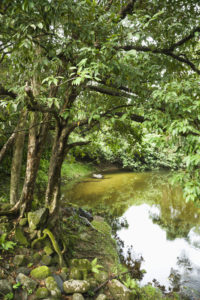
Lush Australia landscape with tree and water

I listened to a radio program today (a repeat) about Aussies trying to understand the concept of COUNTRY and an Anglican Priest talked about how she is trying to “listen to the land.”

That got me thinking. She emphasised, “Don’t grasp at it! Just let it talk to you.”

http://mpegmedia.abc.net.au/rn/podcast/2016/07/sot_20160731.mp3

Could this become a common practice for us and for children? Could we walk mindfully on this ancient land and learn deep listening of the land? Are we still capable?

Sarah (the priest) describes staring at a tree for a long time to really KNOW that tree. What might that feel like? Imagine slowing down like that every day. How might that change us? How might that affect children?

If we could walk like this without phones or noise or headphones, might we come to understand just a tiny bit of what COUNTRY really means to Indigenous Australians.

Probably won’t happen- but what a wonderful thing for all Aussies to do today, this week or soon- walk lightly on this great land and listen with our whole being. It might teach us to go forward with more understanding of what it could really mean to be an Australian. It might also help us understand and gain a new respect for the traditional owners of this land.

I have occasionally encouraged children to stare at and carefully copy real plants, looking closely at every detail and as the concentration deepened you could have heard a pin drop. These relatively young kids slowed down, focused and were so easy to teach after this 10 minute exercise. I wonder if mindful walking or even just mindful gazing at a tree might have the same effect?

I’ll find out tomorrow!


KIDS LOVE SCIENCE!

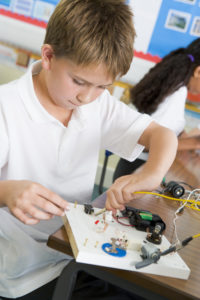
A schoolboy in a science classI am busy choosing our themes and experiments for SUPER SCIENCE SATURDAYS and enjoying imagining the enjoyment of children as they engage in the curiosity raising activities planned.

I was sad to note that Aussie kids are said to be behind in the global science scales. Really?

http://www.smh.com.au/federal-politics/political-news/wakeup-call-australian-students-fall-behind-kazakhstan-in-maths-and-science-rankings-20161129-gszvt1.html

I have taught science for many years as part of our primary curriculum and rarely met a child who does not enjoy it. All children are curious about the natural world and naturally generate intelligent questions. So why would this be happening?

Is this measurement system really measuring science attainment and understanding or is it just measuring the ability to regurgitate formulae and facts?

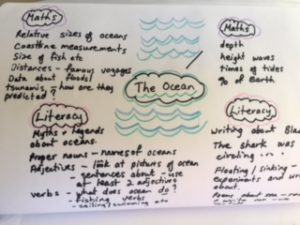
We harness this huge interest in our Super Science Saturday programs by using science as a driver for all literacy and numeracy. E.g. A plan for a unit might start messy like this and gradually move science-blogto a more formal plan with details of the experiments, resources needed etc. I like the kids to suggest future learning activities. They LOVE to have some input!

The thing is- kids have an intrinsic interest in this area so any maths/literacy lessons with science themes are bound to be winners!


A safety net of love and understanding

130514_dkidgirlwallclimbing

At Church today the Pastor talked to us about how God’s love provides a safety net for us and enables us to move forward with confidence knowing we are loved and cared for so fully.

Alison told us that when the Golden Gate Bridge was built, a safety net was put in place, allowing the workers to move about more confidently and safely while incidentally increasing productivity.

This made me think about children in our classes. When children know they are loved and safe to take risks, try new learning techniques and learn from mistakes, test scores and academic performances improve. To put it simply: Happy, supported children learn more.

The safety net that can be built in all educational environments needs to emulate a healthy home environment. Children must know they are loved and safe and not all expected to achieve at the same rates. Without this safety net children will just take the safe path and not take any risks with learning and this means they will not be giving of their best.

A truly high quality system will always encourage students to “stretch” their intellects and go for gold- even if they fall down sometimes. The safety net of love and encouragement will help students stand up quickly, improve their “bounce factor” and learn from their mistakes.

So how do we weave such a safety net? To my mind these factors are crucial:

  • Teachers need to LOVE their students- not in a soppy meaningless way but in a way that respects children and understands that kids make mistakes- they are after all LEARNERS!
  • Teachers with challenging students need real assistance to be able to provide that loving safety net as there are always kids who try the patience of even the most loving and understanding educator.
  • Teachers themselves need a loving safety net of respect and understanding from their admin teams who in turn need it from their departments. Teachers who are not free to try our new techniques and whose only concern is to get kids to pass tests will NEVER get the best academic results from their students. Fear is a very poor teacher.

A loving safety net to help all students feel cared for, respected and affirmed could absolutely transform all education environments- and lift education standards without the pressure and cajoling that occurs so often.

We notice how often children who do our EQ4KIDZ course surprisingly get higher academic results. We really should not have been surprised, given the strong correlation between self esteem and successful learning.

Thanks Alison Gilchrist for your sermon today! I’m going to check our safety net for International Centre for Excellence and make sure there are no weak spots!


I FELL ON MY KNEES


0037-0408-1819-4148


I was saddened to see the peaceful protest in Indonesia turn violent this week.

Recently I visited Jakarta to present some literacy workshops. I met amazing passionate educators and just like on my previous visit, I was struck by the friendly attitudes and smiles from everyone I encountered.

After 2 days of presenting I was ready to relax!  I stood peering into the enveloping darkness from a high hotel room and was struck by the distance and the number of homes I could see. I felt like an eagle!

And then it came: the call to prayer. It started in one place and was soon joined by others all over the city until the night resonated with these sacred words and music. I haven’t a clue what the words say but I was totally struck by the beauty and holiness of the sounds. I have heard the call for prayer many times but this time I felt the power of a whole city at prayer. There was only one thing to do- join them so I dropped to my knees and joined in.

How different the world might be if we all prayed together in this fashion many times each day?

This week as the world waits to see if Americans really would elect a seemingly crazy person as their President, we should ALL be on our knees!

The ABC of Child Whispering: P is for POLITE

Businessman writting the word thank you

Good manners differentiate children from each other.

I was struck by this at an EQ4KIDZ group I taught yesterday. I handed their new workbooks out and each child received it with a polite, “Thanks!”

Sadly, that stood out! So many children rarely say “Thank you” these days and this makes them appear ungracious and ill mannered. Often they’re not- they just don’t know about manners and where to use them.

Kids will not naturally know that picking their nose in public, interrupting, commenting on people’s size etc is rude. They are just being kids.

We have to teach them the social niceties because if we don’t they will be disliked by adults and children alike. Manners are like the oil that helps smooth social interactions and while they may seem rather senseless when you analyse them, they DO have a positive effect. Good manners will always get a better reaction than bad ones!

There are simple manners that promote consideration and respect and these can be taught from a very early age- often as young as 2 years. Help your child to stand out as being kind, polite and considerate. Good manners need to become automatic and if taught well, will become life-long habits.

Children are fascinated to find out about the history of manners and eager to learn how to use them appropriately. We weave them into our EQ4KIDZ program to help children reinforce and strengthen these important habits!

If you model them and insist on them in your homes and while in public or visiting, children will gradually acquire them and this enables them to interact with ease and confidence- great gifts to give our children!

For more information have a look at these links.

http://www.familyeducation.com/life/manners/how-rude-age-age-guide-teaching-kids-manners

https://www.youtube.com/watch?v=kq5h3C4LElE


Tips for cheap, sane “stay at home” (almost) school holidays!


Cute child draws with color felt-tip pens, isolated over white

By Victoria Carlton

  • Lock up the digital devices and chase the kids outside. (When not pouring!)
  • Invite the neighbourhood kids over for casual play- ditch the “play-date” mentality. Just let it happen.
  • Set up a reading time every afternoon for 40 minutes. (This is so YOU can read your book!)
  • Grab a large box and fill with junk- tissue boxes, rolls, empty food packets and containers and plenty of masking tape and scissors. Then ask them to make something. (Don’t specify) Tell them you will spray paint it silver or gold if they really plan their junk sculpture, can tell you about it and write a short description. (You will need to buy cheap spray paint and YOU do this when they are asleep.
  • Restrict TV and encourage painting, playdough and drawing. Sure you get some mess but this is worthwhile fun and they will be learning.
  • Put out food on your bench-top each lunch-time and let them make their own (often weird) concoctions!
  • Encourage children to start a Spring garden. Let them have their own small area to weed, dig and plant some seeds and watch for growth!
  • It’s getting towards that time of the year so ask children to start a list of cards to make and home-made gifts.
  • If you DO go out, visit local parks, go for walks, sketch some plants, visit the local library and at all costs STAY AWAY FROM SHOPS!
  • The wild-flowers are astounding this year so consider a bus to King’s Park. Kids LOVE public transport and it makes a change from the stress of driving and finding parking spots.
  • Let the kids have at least 1 PJ day. (You join them!)
  • Tell them you need a holiday too so keep to reasonable bedtimes so you can relax in evenings and above all encourage sleep-ins!

The ABC of CHILD WHISPERING P is for PICTURES

Processed with VSCOcam with n1 preset

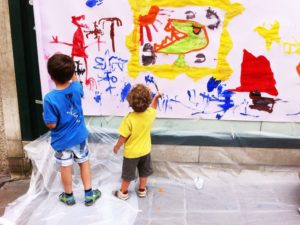
Kids LOVE art. All kids love to draw and paint and generally mess around with mixed media.

They are fascinated with multisensory materials such as playdough – and not just the little kids!

They don’t have the same constraints as us.

When children are full engaged in art they are in another space. I watch the children at my centre totally lose themselves when drawing and painting. They reach that lovely flow state that Mihaly Csikszentmihalyi has studied and written about so lucidly.

The intense absorption we experience in the flow state leads to positive emotions and a generally happier state.

Becoming totally absorbed is good for us and that utter absorption can be seen with art- both when engaged and also when letting yourself disappear into a painting!

We have often used famous paintings as a stimulus for creative writing. We encourage children to imagine they are actually IN the print we are studying and write from that perspective.

Quite often the outcome is not that important to them but the process really is.

Regular trips to art galleries encourage so many skills to develop.

A trip to an art gallery is often a trip into history and children can learn a lot about the world, other cultures and about history.

Children learn to concentrate, get lost in wonder and dreaming and start to form their own preferences.

They learn to respect these public spaces and learn how to interact with the other viewers.

There are always guides and gallery staff to answer their many questions!

Young children all view themselves as potential artists so are not overwhelmed by the great masters.

The trick is to plan the visit and never stay over an hour or 2 at the most.

It is far better for children to really stare, feel, wonder and take their time than to race around the gallery with you and the iPhone, not really looking. The images clicked on the phone cannot compare with the actual art. To really appreciate the art takes concentrated looking and cannot be done with a camera.

The artist and the viewer enter into a special relationship and the viewer might become really engaged (or not, ) generate new ideas, questions- who knows! That is part of the mystery of art! We don’t know where it will lead us!

Model really looking into a picture and letting the picture talk to you. Show them this is a slow, deep process that needs intense concentration and a letting go of distractions.

It is ALWAYS a good idea to take a sketchbook for each child with some coloured pencils. Children love to copy art and that is a wonderful way to learn about lines, form, perspective and so on.

Remember that children don’t always appreciate the same art as you do. Most galleries have comprehensive websites so you can show your children some of the art they will be seeing. Let them have some choices.

Most galleries have children’s areas and these are usually very well planned but DO take them with you to enjoy and learn to appreciate the amazing art we can generally enjoy for free!

As the sign in my centre in Perth says, ” ART MAKES US SMART!”


HAPPY CHILDREN = BETTER ACADEMIC RESULTS

New mindset new results motivational phrase sign on old wood with blurred background

Our EQ4KIDZ course leads to better academic results. This is because children develop an I CAN attitude and therefore stop holding back in the classroom.

They are more positive, resilient and improve general self-esteem and develop an I CAN attitude.

This course teaches kids to understand themselves and develop more positive attitudes.

EQ4KIDZ is offered in Australia and SE Asia. Our goal has always been the same: To help all children reach their potential.

Students are led through art and drama activities, proven to help them understand themselves and others.

Training is also available for schools. We can provide trained teachers to run this transformative course in schools and we are also available to go into schools and train staff.

Readers who are interested in enrolling children in this course can contact ICE on 9271 4200 or email International Centre for Excellence iceinfo@iinet.net.au

error

Enjoy this blog? Please spread the word :)