Tips for cheap, sane “stay at home” (almost) school holidays!


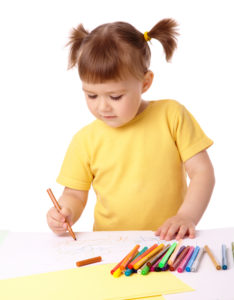
Cute child draws with color felt-tip pens, isolated over white

By Victoria Carlton

  • Lock up the digital devices and chase the kids outside. (When not pouring!)
  • Invite the neighbourhood kids over for casual play- ditch the “play-date” mentality. Just let it happen.
  • Set up a reading time every afternoon for 40 minutes. (This is so YOU can read your book!)
  • Grab a large box and fill with junk- tissue boxes, rolls, empty food packets and containers and plenty of masking tape and scissors. Then ask them to make something. (Don’t specify) Tell them you will spray paint it silver or gold if they really plan their junk sculpture, can tell you about it and write a short description. (You will need to buy cheap spray paint and YOU do this when they are asleep.
  • Restrict TV and encourage painting, playdough and drawing. Sure you get some mess but this is worthwhile fun and they will be learning.
  • Put out food on your bench-top each lunch-time and let them make their own (often weird) concoctions!
  • Encourage children to start a Spring garden. Let them have their own small area to weed, dig and plant some seeds and watch for growth!
  • It’s getting towards that time of the year so ask children to start a list of cards to make and home-made gifts.
  • If you DO go out, visit local parks, go for walks, sketch some plants, visit the local library and at all costs STAY AWAY FROM SHOPS!
  • The wild-flowers are astounding this year so consider a bus to King’s Park. Kids LOVE public transport and it makes a change from the stress of driving and finding parking spots.
  • Let the kids have at least 1 PJ day. (You join them!)
  • Tell them you need a holiday too so keep to reasonable bedtimes so you can relax in evenings and above all encourage sleep-ins!
The ABC of CHILD WHISPERING P is for PICTURES

Processed with VSCOcam with n1 preset

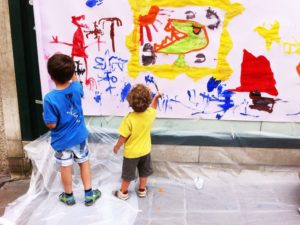
Kids LOVE art. All kids love to draw and paint and generally mess around with mixed media.

They are fascinated with multisensory materials such as playdough – and not just the little kids!

They don’t have the same constraints as us.

When children are full engaged in art they are in another space. I watch the children at my centre totally lose themselves when drawing and painting. They reach that lovely flow state that Mihaly Csikszentmihalyi has studied and written about so lucidly.

The intense absorption we experience in the flow state leads to positive emotions and a generally happier state.

Becoming totally absorbed is good for us and that utter absorption can be seen with art- both when engaged and also when letting yourself disappear into a painting!

We have often used famous paintings as a stimulus for creative writing. We encourage children to imagine they are actually IN the print we are studying and write from that perspective.

Quite often the outcome is not that important to them but the process really is.

Regular trips to art galleries encourage so many skills to develop.

A trip to an art gallery is often a trip into history and children can learn a lot about the world, other cultures and about history.

Children learn to concentrate, get lost in wonder and dreaming and start to form their own preferences.

They learn to respect these public spaces and learn how to interact with the other viewers.

There are always guides and gallery staff to answer their many questions!

Young children all view themselves as potential artists so are not overwhelmed by the great masters.

The trick is to plan the visit and never stay over an hour or 2 at the most.

It is far better for children to really stare, feel, wonder and take their time than to race around the gallery with you and the iPhone, not really looking. The images clicked on the phone cannot compare with the actual art. To really appreciate the art takes concentrated looking and cannot be done with a camera.

The artist and the viewer enter into a special relationship and the viewer might become really engaged (or not, ) generate new ideas, questions- who knows! That is part of the mystery of art! We don’t know where it will lead us!

Model really looking into a picture and letting the picture talk to you. Show them this is a slow, deep process that needs intense concentration and a letting go of distractions.

It is ALWAYS a good idea to take a sketchbook for each child with some coloured pencils. Children love to copy art and that is a wonderful way to learn about lines, form, perspective and so on.

Remember that children don’t always appreciate the same art as you do. Most galleries have comprehensive websites so you can show your children some of the art they will be seeing. Let them have some choices.

Most galleries have children’s areas and these are usually very well planned but DO take them with you to enjoy and learn to appreciate the amazing art we can generally enjoy for free!

As the sign in my centre in Perth says, ” ART MAKES US SMART!”


HAPPY CHILDREN = BETTER ACADEMIC RESULTS

New mindset new results motivational phrase sign on old wood with blurred background

Our EQ4KIDZ course leads to better academic results. This is because children develop an I CAN attitude and therefore stop holding back in the classroom.

They are more positive, resilient and improve general self-esteem and develop an I CAN attitude.

This course teaches kids to understand themselves and develop more positive attitudes.

EQ4KIDZ is offered in Australia and SE Asia. Our goal has always been the same: To help all children reach their potential.

Students are led through art and drama activities, proven to help them understand themselves and others.

Training is also available for schools. We can provide trained teachers to run this transformative course in schools and we are also available to go into schools and train staff.

Readers who are interested in enrolling children in this course can contact ICE on 9271 4200 or email International Centre for Excellence iceinfo@iinet.net.au

The A-Z of Child Whispering : O is for Organised

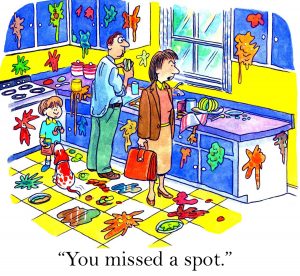
"You missed a spot."

Children don’t feel safe when everything is disorganised and random.

They may appear to like lots of surprises and exciting “happenings” but it can lead to overload and frustration.

When children constantly have their routines interrupted, they feel distracted and unfocused. They need routine and strong boundaries. They look to the significant adults in their lives to provide these.

They are encouraged to do so many after- school programs that they don’t have the chance to just play, dream, wonder or integrate all their experiences and make sense of them. This leads to very low Intrapersonal intelligence.

Believe it or not, children thrive in organised classroom and home environments but need a little wriggle room in both!

Many wise teachers are now giving the children free time once a week – even half an hour puts a smile on their faces! The big complaint from children to me is always that they have no time for free choice and play.fstickmankidsflyingkite

At home, parents can ensure the children have at least one afternoon spare after school!

Organised children tend to learn time management skills at an earlier age.

They learn to timeline their homework assignments, improve study skills and actually finish things before starting the next thing.

They know what is expected from them and understanding expectations is a key skill for successful social skills.

Here are some tips for busy teachers and parents-

Firstly, get YOURSELF organised.  Organise your time and

belongings and make sure your class or family notice the changes.

Draw up a time-table and share with children. Stick to it and do the important things first.

Limit the number of after-school activities children do so they can finish homework and have some free time for play, wonder and dreaming.

Folders in the open file cabinet

Show children how to get organised for the next day. They can pack their  school bag, important books etc and get lunch organised.

This avoids the frustration and confusion that can reign on busy mornings!

Ensure there is a place for EVERYTHING and children know where it is. If possible label everything.

Insist on children doing some chores so they begin to develop a sense of responsibility.

Plan meals and involve children in those choices and allow them to help prepare the meal.

Minimise screen time. Constantly jumping from app to app and watching programs with large amounts of ads will wreck their concentration skills.

Insist on a reasonable bed time and stick to it.

Even if they cannot sleep and need to read for a while, they will eventually adjust and we know from research that rested children absorb more information in class.

Also- parent time is valid! You need time to think, plan, organise and relax.

If you help children develop time management and organisational skills you will be giving them a life-time gift!


“Vicky – the words just won’t come out.”

Unhappy Male Student Working At Desk In Chinese School ClassroomThis sad statement came from an 8 year old. At this age children should be bubbling with creativity and ideas. If they know HOW to write words, the words and ideas should flow eKia Hui 2asily from the brain to the page. Asa 1

And yet, like Andrew, so many children find the reverse is happening.

They are constrained from a fairly young age to write in various genres such as persuasive text, reports and so on and cannot JUST LET THE WORDS FLOW!

it is the same with any creative pursuit- put too many rules in too early and the ability to get into flow just goes!

I am happy to report that ALL children who attend our courses for more than 3 months CAN let the words go- in fact they love the process!

We write in short spurts (8 minutes) with no talking aloud and Scarlett 2nobody is allowed to not write (even teachers as well.) The kids double, triple and often quadruple the number of words they write.

We have developed many methods to restore children’s ability to write creatively and MIND JOURNEYS is a very powerful strategy.

We have used this method for many years and we are continually adding more visualisations (mind-journeys) for children to listen to with eyes closed in a darkened room. A teacher reads them calmly and slowly with the children cross legged in front of them.

A child rings the writing gong to commence writing and one to finish at the end of 8 minutes.

Lights are deliberately kept low to aid concentration and focus.

The kids start to switch on their imaginations and imagine they are IN the stories!

Once the writing gong has sounded the children have no choice- they are told to put pencil paper to paper and write about whatever came into heir minds.

Most just ge491506[1]t writing quickly but occasionally I might have a child just sitting, not sure what to write (usually a new child) and I just tell the, “wiggle your pencil around on the page and something will come out!” And it does!

Of course we also teach editing and the basic genres but we give priority to the creative aspects of writing so children, even the most reluctant ones, can re-discover their writing voices.

Our new MIND JOURNEYS book is now available in Singapore and will be available from the beginning of October in Australia.

Please contact us to get a copy so you have 50 Mind-Journeys to help the children in your class to LOVE writing.

Teachers who sign up for our next ALL KIDS CAN WRITE course (Thursday 25th October) will receive a free copy, learn more about this approach and be given a practical introduction to the other methods we have evolved to get our students to LOVE WRITING!


SAD CONVERSATIONS

bambino disperato si copre il voltoAlmost everyday I have sad conversations with parents and children about school work and homework they cannot understand.

A little challenge is healthy but to be constantly confronted with work they have no chance of succeeding with is just plain depressing. Then – just to rub salt in the wound, the NAPLAN results arrive and another nail is driven into the coffin of self-esteem!

F grade and a sad smilie, written in red letters in a spiral pad, shallow DOF

Of course there are curriculum guides that tell teachers the content expected to be mastered at different grade levels BUT a teacher’s task is always to take a child metaphorically by the hand and lead them through the curriculum. If they have not reached a certain stage you cannot just MAKE this happen. Children need to be given work they CAN do and then be shown how to get to the next level.

Children are not machines to be suddenly accelerated by a switch. They are wonderful gifts from God for us to nurture, love and lead gently through the education maze.

There is NOTHING more demeaning than to not be able to do school work all day (with classmates teasing and goading) and then to be given homework that you can’t do either. Schools need to be aware of how many families spend hours on homework tasks every night with resultant frustration and tears. These kids are not getting time to play, chat, daydream and generally be kids.

There is very little evidence that copious amounts of homework help children at all. Reading, practising basic spelling, phonics and times tables is appropriate. Any more than 30-40 minutes per evening is too much and children under 8 should have even less.

We need to stop robbing children of their childhoods and help them at point of need.

That’s why tuition that targets specific skills not understood, and that builds self-confidence and self-esteem really works!

The A-Z of Child Whispering O is for OPPOSITIONAL

Children Fighting In Front Of Mother At Home

What does OPPOSITIONAL mean?

You want the child to do one thing and they want to do the opposite.

Don’t we ALL have this at times? (I’m sure my husband would agree with that one!)

Why do some children become oppositional?

They do it because they don’t want to do what you want them to do. Simple!

What child ever wants to go to bed, pick up their toys, finish vegetables they hate, do boring homework or quietly accompany someone around a long trip to the supermarket, share toys with another kid they don’t like ……… (The list goes on!)

EVERY child in the world has had this so-called disorder at some stage.

Some kids are very strong and independent and really want to try to stand up to you, defy you and get their own way! (Could actually be a rather warped sign of strength and leadership!)

However, kids HAVE to learn to play the “game” and behave.

If parents don’t discipline their children, the world will!

You do know more than your child and you are the boss.

If no rules in the house- children will simply walk over you and demand their own way. They are wired to do this.

  • Make house and class rules and where possible involve children in this process. However, tell the kids about the non-negotiable rules- particularly the ones related to safety.
  • Stick to your rules and don’t threaten. Give a couple of warnings and then apply the consequences. It might be an isolation chair, quiet time in room, cancellation of privileges etc. No matter what you choose- make the consequences clear and STICK to them.
  • Begin straight away – if you ignore constant bad behaviour it just gets worse. It is OK to tell kids you understand how they feel. It is also OK that you tell them that some things are hard but we have to do them! This is part of character building.

You deserve some peace and quiet and you don’t want your home or classroom to be a constant battleground. It doesn’t have to be.

However, make sure you-

  • Do not have unrealistic expectations. Children cannot always be clean, neat and quiet.
  • Check children’s diets as many common foods contain additives that lead to low-level aggression.
  • Allow plenty of non-screen time and ensure they get outside and exercise.
  • Restrict time on digital media- it can lead to irritation and low level aggression.

We now have a label for oppositional behaviour:

Opposition Defiance Disorder (ODD)

Experts tell us that ODD kids might go on to develop Conduct Disorder. (CD)

Is it possible these kids actually have OOCD? (Out of Control Disorder) or NKS ? (Naughty kids syndrome)

This medicalisation of childhood needs to stop.

Take control today.

Why are Jolly Phonics and Jolly Grammar in the Victoria Carlton Programs?

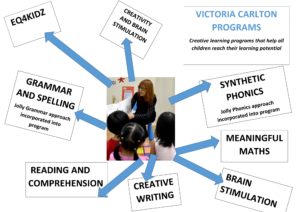
MODEL OF VC PROGS

Many people ask me why I have always included JOLLY LEARNING as part of the Victoria Carlton programs.

Reason is- they work! They help ALL learners to grasp the all important basics of phonics and grammar.

Then we use our brain stimulation, literature, comprehension and writing programs to build on this skeleton and add the “flesh” so that children become fully literate and really enjoy the process.

I refuse to use any program that is not grounded in careful research as children are not guinea pigs- they deserve the best- ALWAYS!

This is the reason we always include JOLLY LEARNING in our training for new licensees.

My vision for all students at my centers around the world to be fully literate and able to speak, read and write clearly in English.

Any of you who would like to know more about our licenses or programs for schools and children- please contact us directly at victoriacarlton@ iinet.net.au or call on 08 9 2714200.

Alternatively, if you are reading this in South East Asia, please contact Chew Yeh <chewyeh@september21.com.sg>


error

Enjoy this blog? Please spread the word :)