
HE’S NOT THERE YET!

Last week was the last week of Term 1 here in Western Australia. This means teachers worrying about children who have not reached desired levels in various subject areas. It also means anxious parents who get told comments like, “He’s not there yet.”

What does this really mean? The child I have in mind here has struggled with literacy skills for 5 years . He took longer to develop phonological awareness and start reading. Unfortunately for Jamie, (not his real name); his school did not use a synthetic phonics program so he lacked tools to begin his literacy journey.

I now have him on a strong phonics and individualised literacy program and he IS making progress. As Jamie also has HUGE self-esteem issues and is regularly bullied, paying attention in class is difficulty for him. He has told me he is terrified of play-times! I am helping him become more resilient but WHY should this happen? He is called, “Veggie,” because he struggles, tripped up, has his lunch stolen most days and  last week was told to , “toughen up!”

His mother came to me crying last week. His teacher had told her “He’s not THERE yet and I am not sure he will ever be!”

My point is- where is this mythical THERE?

Why must we all go there at the same time?

Why can’t we go somewhere else first or follow a different pathway?

Why must we treat kids like robotic machines who have not achieved the correct speeds, skills etc?

Why do we still accept ANY bullying in our schools?

I rejoice in my kids who are not THERE! They are somewhere else instead and they teach me more than I teach them. Of course I work to improve their literacy and maths but I know there are many paths to get there and we don’t want literacy clones- we want thinking, feeling REAL chilldren with all their gifts, failings and differences.

Let’s celebrate EVERY CHILD and their amazing potential and open our hearts and brains to the possibility we may actually be wrong. That failing child might actually be a creative genius who needs a different approach.

Jamie is! He is already a gifted artist and poet and yet not honoured for these skills!

Please email me direct at victoricarlton@iinet.net.au if your child needs some help to find their learning pathway.  As part of my very different educational assessments, I assess learning style and look for strengths as well as weaknesses.


The ABC of Child Whispering: U is for UNIQUE and UNUSUAL

I teach children who are unusual.  The usual strategies have to be put away and I am forced to think out of the box.

I am like an explorer whose maps don’t work.

How do they learn? What do they need?

If you have an unusual child, please honour them. Celebrate their difference. Look for their gifts. Reassure them you are there for them.

Don’t be too quick to put a diagnosis on your child. Use your intuition and just love your kids through it all- unusual kids tread a very thorny path- they need love and understanding.

These kids will be our leaders, our innovative thinkers, our entrepreneurs. They are the ones who will help generate ideas to solve climate issues and get the world out of the mess my generation put it in!

These kids are the ones who make me dog- tired every night but immensely stimulated and happy!

Just over the last few term we have:

  • Written a book with comprehension and spelling about UNIVERSAL studios in Singapore for a child who has just returned.
  • Helped a child who LOVES fairies to “elf” herself by placing her photo in an elf picture and then to write about it.
  • Discussed the possibilty of unicorns existing and used them in art.
  • Designed a literacy program around an app FARMING SIMULATOR 19 to re-engage a child.
  • Helped a small group to learn about features of report writing by choosing their favourite animal- the PENGUIN as our focus.
  • Designed a series of MAGIC MIRROR lessons for a small group who love fantasy but need help with elements of narrative
  • Helped a child to make a “maths drum” to practice counting and mental facts.
  • Designed digital notebooks for all our students to use with our i-pads.
  • Made an art project for a child to learn the “ig” word family.
  • Taught kids about fractions by cutting up pancakes and waffles!
  • Found novels and picture books to fit with children’s interests and needs
  • Used JOLLY PHONICS and JOLLY GRAMMAR to accelerate children with learning gaps- written our own support materials for children who take a little longer to absorb these concepts.
  • Tomorrow we will be doing lots of messy experiments about eggs, Easter and weather for our Super Science Saturday group.

I could NEVER get bored. And guess what? There are many teachers like me who prove you CAN individualise programs. It is hard work but these capable, unusual kids NEED programs that engage and utilise their interests and strengths. It is well worth putting in the time and effort.

Occasionally we hold CHILD WHISPERING workshops for teachers and parents who would like to know how to individualise the curriculum. Let me know if you are interested.

Anyone interested in our individualised and vibrant, exciting group tuition or teacher training and licences- please contact me on 0409911135, 92777596, victoriacarlton@iinet.net.au

In Praise of Teachers

Yesterday I gave my last JOLLY LEARNING session for this term to teachers at a WA school.

I could see tiredness etched into their faces as I began my 3 hour session. (They had already taught full classes all morning!)

I knew that as soon as we finished they had parent interviews to arrange so were probably working at least 10-11 hours!

And yet- they concentrated fully, took notes, ask HEAPS of questions, laughed at the silly videos I showed and even stayed back to ask me more questions.

Their dedication was so apparent as they shared successes and concerns and I was struck by their level of passion for their students.

They had bothered to reflect and come with all their questions and I LOVED running this workshop.

To be honest I enjoy running ALL of my training in literacy or emotional intelligence because teachers are amongst the most creative, hard – working, passionate and dedicated professionals you could ever meet.

We need to honour them more and realise how precious they are- they truly are transforming the next generation.

Tell them how much you appreciate all their efforts- put a smile on a tired teacher’s face today!

BET YOU’VE NEVER USED THIS SPELLING METHOD!

Children are amazing! We need to learn from THEM!

I was recently working with a child who has difficulty processing sounds as she writes. We had tried various methods that “sort of” helped but there was some distance to go!  Her reading was rapidly improving- but NOT her spelling!

She is a very observant child and always looking for an adventure!

I have some castanets I use to introduce the c/k/ck sound in Jolly Phonics. Sophie’s sharp eyes spotted them and wanted to know what they were and why they were in my classroom.

I explained and she seemed to be happy. We continued sounding out some words from our word-lists, clapping out sounds and tapping on the table.

Suddenly, Sophie stood up and grabbed one of the castanets. She started sounding out words while clicking the castanets- a click for each sound!  I stared as she confidently worked her way through the word list.

When we moved into dictation she listened carefully and then wrote every word with  100% accuracy as she literally clicked her way through each word.

I just sat there in complete shock. After all my methods, apps, games etc- she chose something that worked for her.

Sophie is going very fast with her spelling skills now and this is largely due to “CLICK SPELLING!”

Try it- it may or may not work for your children, but the real take-a-way is to allow children to have some choice in methods that work for them- and they might be unusual!


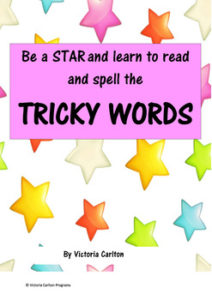
FREE PRODUCT TO TEACH TRICKY/SIGHT WORDS

Throughout my teaching career I have worked with children who struggle to learn these pesky words that generally cannot be sounded out- so must be learned by heart.

That presents a problem as kids these days HATE rote learning and will do all they can to avoid it.

When I wrote this product I was determined to come up with interesting ways to get kids excited about these essential words.

Without being able to read and write these words, kids have NO chance of reaching full literacy.

I have made this product FREE so just join TEACHERS PAY TEACHERS, (https://www.teacherspayteachers.com/,) find my store-Victoria Carlton Programs and follow me. The free TRICKY WORDS package is my featured product and as mentioned, it is FREE!

Don’t forget to follow for more great freebies coming over the next few months.

This very full – 9 part learning package is designed to help children learn to read and spell the 72 TRICKY words taught in the first two years of school. It follows the same sequence as that used by the JOLLY PHONICS program.

However, the learning activities would suit the needs of any young literacy learners.

The suggested learning activities can also be used to help older children to close the gap and achieve better literacy outcomes.

WHAT IS INCLUDED IN THIS PACKAGE AND HOW CAN IT BE USED?

1. Suggestions for multi-sensory teaching of the TRICKY WORDS.

2. Strips of TRICKY WORDS to read and trace.

These can be stapled into paper chains to decorate literacy centers and classrooms.

The TRICKY WORDS can also be glued into children’s writing books for reference and practice.

3. Sentences for the reading practice of tricky words.

These can be copied, cut up and used as flashcards. Children can read these words and also be directed to copy them for spelling practice. The TRICKY words are underlined.

4, Sentences for tracing whole sentences that use tricky words.

These can be copied and traced by students to reinforce the spelling of TRICKY WORDS. They can trace with bright colours to aid memory.

5. Sentences for children to read and insert the missing TRICKY WORDS.

6. A TRICKY WORDS sort

7. A PowerPoint of all the 72 TRICKY WORDS

8. A recording form for you to mark off when children have mastered the words. This form can also be used for flashcards.

I suggest you make a copy for each child.

9. Certificate for children who have mastered the TRICKY WORDS.

I have also made a certificate for children who are trying hard but haven’t yet mastered the words.

ENJOY AND REMEMBER TO FOLLOW FOR MORE GREAT LITERACY PRODUCTS!

The ABC of Child Whispering: T is for TEMPER TANTRUMS

We are all familiar with the 2 year old temper tantrums and feel sorry for parents as they try to coax angry (and often very cute) children to calm down.

We feel less sorry for parents of older children who “lose it” in public. These kids are often ridiculed and teased by their peers and in fact goaded as they provide ready entertainment in the classroom.


We tend to label parents of these children as laissez-faire, ineffective and uncaring and yet the reverse is often the course.

Some kids have huge problems coping with big emotions and need help to handle their anger. They don’t want to be out of control and desperately need intervention.  It is as if they have more triggers than other kids and need to desensitise them.

We help students with anger management problems within our individual and group learning sessions and employ a range of very practical measures to help children self-regulate.

Please email me on victoria@vcprograms.com for specific advice and recommendations, or call Victoria Carlton programs on 92777596 or 0409911135.

We also have our EQ4KIDZ and ART FROM THE HEART programs to help children understand their feelings and develop a more positive mindset and higher levels of resilience. We help these children grow an extra “skin” so they can lengthen the time from stimulus to response.

They CAN all be helped but it takes time, patience and persistence. Their parents need support, empathy and encouragement- not unhelpful criticism.

These links have some helpful ideas:

https://raisingchildren.net.au/toddlers/behaviour/crying-tantrums/tantrums

https://childmind.org/article/why-do-kids-have-tantrums-and-meltdowns/


Beginnings are magical….

We are 3 weeks into term and kids have been excited about getting back to school, seeing their friends, meeting their new teachers and so on.

They have been bringing their brand new text books and reading books along to show us and even excitedly showing us homework programs and exam dates. There is ALWAYS some excitement about the start of the school year- they are filled with hope and optimism and the scent of new beginnings.

I love this time- each year it feels like the regeneration of the earth after the Autumn summer rains!

However, sadly any inherent problems start to emerge again.

Some of our children are already feeling dejected as they face the disappointing results from beginning of the year testing, realise the homework HAS to be done and that they still experience problems.

A number of young children have told me, “I am dumb, Vicky. I’ll never be good at school work,” and similar statements.

We are weaving lots of positive mind-set activities into our teaching sessions in an effort to build resilience and positive, I CAN attitudes.

To sum up, there IS magic in these early school days but let’s be well aware of the hurt and disappointment starting to emerge from low-performing students. Let’s make sure they get the support and empathy they need rather than the negativity and blame that unfortunately often comes their way.

Any readers who would like to discuss problems with their children, please email me on victoria@vcprograms.com so I can offer you some helpful ideas and support.

REAL-LIFE MATHS


So many of our students HATE maths and cannot see the relevance to the real world. They can’t join the dots from what they learn in the classroom to how real maths is essential to our world!

We have set out with our MAKING MATHS MEANINGFUL program to remedy this. We want our students to join the dots and see how relevant maths is to EVERYTHING!

We noticed many of our students have been experiencing difficulties with money problems.

We often use the shopping catalogues from our mailboxes and ask friends to collect for us. Then we utilise these catalogues to help students problem solve using undertanding of our money system.

This week we managed to get some K-Mart catalogues and we have written some maths problems designed to utilise the mathematical opportunities offered by K-Mart this week!

Kids LOVE this very relevant, “hands-on” approach!

WHY GROUP TUITION WORKS

I have provided tuition for hundreds of students over the last 20 years and one thing that stands out is the success of small group tuition.

Why is this?

This is what I think is happening:

  • Children are social creatures and they love to know others have difficulties as well.
  • Problem solving, interpersonal and conversation skills are difficult to teach without a group context.
  • Students bounce their ideas off each other and when we share ideas, writing, ways to solve maths problems etc they enjoy learning about other perspectives.
  • There is plenty of opportunity for humour in a group as well as discussing common problems without necessarily identifying the person who is having the difficulties.
  • Language is best learned in a social context with plenty of opportunities for oral interactions and fast feedback. Literacy is literally built on a base of talk!
  • In a group context we can play many learning games and we know learning increases when children are relaxed and play games.
  • Quite a few of our students, (some who have great difficulties making friends,) have made firm friends withi the group.
  • A group can have rituals and traditions. We always say our motto, acknowledge custodians of the land, do some Brain Gym, review previous session’s learning and set new goals. We call this time THE GATHERING and if we miss it the children are pretty annoyed! They love this sense of community.

4-8 children works well for small group learning. Many more and children don’t get much attention. Many less and there is not enough interaction.

I found this blog post from a UK tuition company quite interesting and it expands this topic a little further:

5 Benefits of Small Group Learning

Call us on 92777596, 0409911135 or email victoriacarlton@iinet.net.au for more info about Victoria Carlton Programs.

The ABC of Child Whispering: T is for TESTS

Tests are important. They can be signposts along a child’s educational journey showing us whether they have understood and where we need more revision.

Provided the tests are well written and paired with successful teaching practices and adherence to the curriculum, they can provide revealing information.

They help children to realise if they don’t  study they may fail and also to be able to clearly see areas that need more work.

Judicious testing and feedback can actually help students develop resilience and awareness of their strengths and weaknesses.

However, we have now approached the over-testing zone in Australia. Many students we teach have weekly tests and their study consists of test preparation rather than carefully lessons and planned study timetables.

Anxiety is high and parents are forever talking about test results rather than progress.

Children with serious learning difficulties should never be subjected to the continuous FAILURE  loop with its accompanying feelings of hopelessness and depressive tendencies.

Sadly, this is happening at a time when forward looking education systems are lessening reliance on tests in favour of improving teaching strategies and taking note of students’ learning styles.

Singapore has recently loosened the straps on their system to allow more choice, thinking skills and creativity. Children in Finland sit for very few tests and yet their academic results lead the world.

Why do Australian Education authorities choose to ignore good practice principles and continue with over-testing?

Parents need to be aware when their children are being over-tested and try not to stress children about results.

Both the primary and high-school school systems need to help children learn the basics but also be challenged, extended, develop curious natures and therefore develop a deep love of learning.

Over-reliance on testing and results often means students are not given study skills or helped to develop emotional intelligence and general life skills.

This article provides more information:

https://www.news.com.au/lifestyle/parenting/school-life/why-students-arent-prepared-for-life-after-school/news-story/0b88ea7a7ef15406e49e7fcbddba3a5d