
NO TIME TO IMAGINE ANYMORE!


imagination


We are once again losing the plot!

Schools are using NAPLAN as their excuse for turning themselves into efficient factories with kids having knowledge rammed into them reminiscent of Dickens’ HARD TIMES scenarios!

Of course we have to improve young minds, help children retain knowledge, remember facts and spell, read, write and do basic maths. Nobody would argue with that.

But…we also have to inspire, light the fires of curiosity, lead, excite a love of learning, teach how to know oneself and how to be with others. We are called to be EDUCATORS and truly educating a child is a complex task calling for highly trained, sensitive and empathic human beings to lead, motivate and awaken hearts and minds.

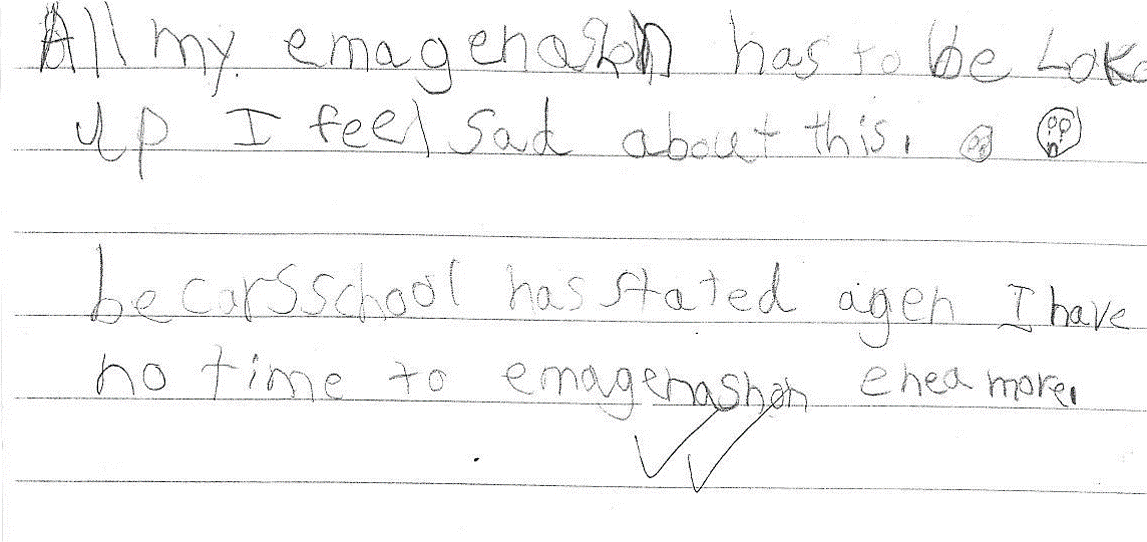
This young extremely intelligent 9 year old had some literacy issues and LOVED the school holidays because she could dream, imagine, make things (she was a gifted little artist), and just be herself. As soon as school started her imagination had to shut down.

She came in crying one afternoon and thrust these words into my hands. I could hardly speak. I asked her if she would mind if I shared her words with teachers and her reply? “I WANT YOU TO!” So here I am sharing this child’s honest comments.

Let me translate:
All my imagination has to be locked up. I feel sad about this. Because school has started again. I have no time to imagine any more.

Surely we should be doing the opposite? Surely we should be awakening their imaginations by reading them great literature, providing enriching experience in the arts, music and movement and promoting divergent thinking skills?

Is this the bleak future we are offering? In that case we can expect more children to tune out, lose interest, become sad, depressed and lose the ability to dream up the future. We need to wake up from this nightmare and give our children back their hopes, dreams and futures.


JOY OF JOURNALS

journalsI am excited! We have only re-instituted our writing journals for 3 weeks and they are WORKING!

Not only are they working- we know the students more closely, they know themselves more closely and the standard of writing and fluency has already improved!

These were the steps we took:

1. Gave them a dedicated journal book with NOT TOO MANY PAGES!

2. Showed them what journalling looks like. I took in my I-PAD journal and gave them a look at how I use the Note-shelf app to keep a locked journal with both words and pictures I draw. In a couple of weeks I will re-invigorate the process by showing them older print journals I have and talking to them about how re-reading them helps us to know ourselves.

3. One child rings the gong and we write for 7 minutes. The children do not share- they can write words, draw pictures about ANYTHING. I tell them that a journal is NOT a diary. It is not just for recording events although they may be in there. It is more about our feelings, perceptions, dreams for our life and is therefore written at a deeper level. We are examining our thoughts and feelings within our journals.

To be honest I thought I would meet with more opposition but so far so good! We do give possible topics e.g. This week is Halloween so they might want to write about something scary, or they can write anything they like. Quite often we will actually model the process in front of them. Last week it was Deepavali celebration so we encouraged children to write about people who are shining lights in their lives. Many of the children selected that option but some of them had other issues to explore and we gave them the freedom to do that.

Try this with your own children at home or with your class. I have used it with students from approximately 4 -16 years with great success. The important thing is to let them know you will be reading their journals and writing back to them. If you do not say this NEVER look in their journals. Some of the older children ask if they can staple paper over their entries so we do not see certain private things. That is fine and we never violate their privacy. Most children LOVE to have comments, questions and reactions to what they are expressing. I find some of them have even started asking us questions so they can get to know us better!
I was working with five rather honest girls last night (7-10 years) and after they finished their journal writing one boldly asked, “Whose idea was this- to get us to write in journals?” “Mine!” I answered waiting for the sharp words that often follow such a question!
We LOVE them, answered the children and then they all told me how they love the little books, writing down their thoughts and reading what we write back to them. This sort of approval is pretty hard to come by so go for it- it might work for your kids as well!

LIFT THE LIMITS ON LEARNING!

I love FractionsCongratulations to our wonderful student who did so well with FRACTIONS last week at school. Charlotte is an excellent example of a very bright child whose learning style does not always coincide with the ones offered in school.
Ask her ANYTHING about nature and she will astound you! Charlotte is our consultant environmentalist and keeps us all up to date with endangered species etc.
We use teaching techniques that often leap ahead of the curriculum. Some children hear it, disregard but register the information somewhere deep inside, some grab it because they are ready and Charlotte was one of those!
This is what happened with fractions. Because we use a multi-age approach Charlotte had the opportunity to hear older children learning about fractions and when her class eventually started it she KNEW and recognised the concepts. She absolutely ran with it and proved to herself, her class and her teacher and adoring Mums HOW SMART she is and of course this is now a corner turned for Charlotte- not just a corner- a veritable U turn! She knows she CAN do it now and I know for sure the rate of progress will now step up!

We need to stop putting age-limits on learning- give them the knowledge when they are ready!

MULTI AGE CLASSES = MULTI-BENEFITS

There is considerable evidence supporting multi-age groups for teaching.
We have always followed this approach and see many benefits:
• Teachers teach children at point of need rather than being confined by perceptions of age levels.
• Children can get access whatever help and teaching they need in flexible groupings.
• More able children tend to be fully extended.
• Children with difficulties feel more relaxed about accessing much needed questions and will ask questions more readily.
Essentially this is modelled on natural family groupings and honours the fact that we grow and mature at different times, sometimes with “spurts” and sometimes more slowly.
Teachers who teach this way develop the ability to be more flexible and use more learning games and “hands-on” equipment.
Of course teachers who teach in these environments need some support, coaching and modelling in this teaching method. It is like conducting an orchestra and once you know how, you just get better!
We believe the educational gains are great so if you have the chance to teach in a multi-age environment, take it! You have much to gain!
Parents who have the chance to enrol in multi-age classrooms or tuition centres- know your children are experiencing an excellent education mode and likely to have very tangible social and academic gains.

THE RITES OF SPRING FOR KIDS

Happy little girl playing with bubbles

Our kids at INTERNATIONAL CENTRE for EXCELLENCE are excited! The scent of SPRING has them dreaming of beaches, picnics, outside fun, art in our ICE garden and more. There is always a sense of holding our breath just before a seasonal change!
Teachers are feeling much the same! Our WINTER THEME TRAY will now give way to scores of potted plants, paper flowers, enchanted forests and whatever else the children dream up! Enthusiasm is renewed.
It is interesting that even though our winters are mild in WA we still have that sense we have been ensconced in the depths of winter and in a sort of deep, dreamlike sleep!
Here are a few ways that we can all celebrate the rites of SPRING with our pupils- Pre-School through Primary to Secondary:
• Make gratitude lists and add each day or show children how to begin a gratitude journal. (Model this by keeping one yourself.)
• Start a new garden bed- fingers in the soil, add compost and dig, plant and nurture some seeds.
• Write SPRING goals for learning, out of school, sport etc.
• Remind children that Spring is about new beginnings so they can consider new interests and hobbies.
• Help to spring-clean their rooms (and classrooms!)
• Draw some plants- really look at them closely.
• Record some bird calls and try to identify birds from sounds
• Plan a regular weekend picnic.
• Get outside to do writing/art or listen to a story! There is plenty of research that shows changing the learning environment and venturing outside will improve learning outcomes.
• Pack away some heavier clothes and give away old clothes.
• Make a list of things we can do in Spring that couldn’t be done in Winter!
• Choose books that focus on spring themes such as baby animals, plants and the environment.

ABOVE ALL- ENJOY THE HOPE, THE STIRRINGS AND THE OPTIMISM OF SPRING!

CHILD WHISPERING WHILE TESTING

When children are being tested, evaluated or assessed, they are often very nervous. It is hard to get their best performance while they are nervous- so this is the time to apply some CHILD WHISPERING! If you really want to know what they have learned and HOW they have learned you will need to watch and listen with your hearts as well as eyes and ears! There is always a sub-text and a CHILD WHISPERER takes the time to understand this!

  • Reassure the child that you are just seeking info to help you teach more effectively.
  • Watch their body language and help them to relax by chatting, getting down to their level (physically), and explaining the task calmly and clearly.
  • After the test, ask them how they think they went.
  • Make sure you let children know that all you expect is for them to give of their best!
  • When you mark the test, make sure you use mistakes to find out exactly what types of miscues have been made and discuss these with children.

Children need to know that you will take the time to get to know them. They do not give up their learning secrets easily- it may take a long time so keep watching, waiting and gently probing. They are like precious pearls you need to move around to look closely and make sure they are growing well so they can be returned to the ocean!

TAKE THE TIME- YOUR PATIENCE MIGHT JUST BE THE ONE FACTOR THAT WILL SAVE THIS CHILD’S SELF-ESTEEM AND CHANGE THEIR FUTURE LIFE!

We will be discussing the specific strategies effective CHILD WHISPERERS can utilise to get a full picture of the child’s learning as part of our future course: HOW TO BECOME A CHILD WHISPERER in OCTOBER. Please email Ngo Chew Yeh chewyeh@september21.com.sg for course dates and info. This course will begin in February 2015 in Perth as well!2 hearts

HOW TO CHILD WHISPER

As usual after our annual holiday, I start updating and writing new content for all our courses. For a long time I have known I should write a course on CHILD WHISPERING and share what it really entails and we are launching this course in Singapore in October.
As I write this course and consider content and ideas one concept becomes abundantly clear- this cannot be learned at speed. It takes time, patience and acute observational skills to learn to “Child Whisper”. You have to do the following and a great deal more-
* Be prepared to find out many of your assumptions and beliefs about the child were wrong. Be prepared for some surprises!
* Learn to get back into your “kid-spirit” and look at the child from a fresh perspective.
* Be WITH the child and don’t try to always lead. You need to earn their trust and this can take a long, long time!
* Understand that if you do not really LOVE children, you will NEVER succeed at CHILD WHISPERING because they will know! Children are far more discerning than adults and they see right through imposters!
Is it worth all the energy and time? Yes, yes and again YES! When you can really develop that empathy you can easily understand a child and provide for their needs and this makes a HUGE difference to their learning!
I will add more on this subject over the next few days as I make my long journey back to the world of WA, winter and responsibilities- the holidays are over and new beginnings are appearing! If any of you are interested in attending the 1 day CHILD WHISPERING workshop in Singapore in October, please contact Chew Yeh at www.september21.com.sg. We will also offer this workshop in Perth from February next year!

PARENTS FRIGHTENED OF CHILDREN

I was talking to a very dedicated teacher last week who told me she has lots of parents who ask if their children can have a “rest” from homework as it makes them angry and upset. I experience the same phenomenon- parents asking for a “rest” from learning for a couple of terms- often for children who are 2-4 years behind in their learning but have normal intelligence.
So why do they need a rest?
Why are parents saying things like:

  • “I just can’t get him to work”.
    “When she gets angry I just have to give in- it’s too hard!”
    “The pressure is too much.”
    “She won’t read.”
    “She refuses to learn her spelling.”
    “The program is not working.” (After 3 sessions!) What they mean is “My child is not working!”
  • Why is this happening?
    What is the “rest” from?-
    Success?
    A happy future?
    Reaching a reasonable standard?
    A satisfying career?
    High self-esteem?
    A great sense of I CAN and resilience?

So- parents wake up and realise if your child has a problem with learning – stick at the chosen solution. If your child is two years behind, why do you think it will be cleared up in a few weeks? Yes- it WILL take hard work. Our teachers will identify problems and do their best to help your child. Your job is to ensure your child does their work. We prefer not to take children if their parents are not committed to helping them and able to insist on daily practice.

Of course children will whinge and complain. It’s hard work and they don’t want to do it! Do you like to do things that are hard?

Learn to ignore the constant negative stream and make them do the work anyway. They will thank you one day.

A colleague quipped recently, “Parents who give their children a rest should be a-rested!”
YOU are the parent and THEY are the children. This means YOU are in charge and as YOU are the adult- act like one and make sensible decisions that will benefit your children.
Tough love is more real than taking the soft option that will likely lead to a miserable future!

GROW UP PARENTS AND TAKE YOUR POWER!

SPELLING DOES MATTER

Thinking about spelling today and ploughing through a lot of older and recent research. Nothing new seems to ever come up in this area. I honestly think there are a few facts and once we know these it is up to us as teachers to just make sure we pass them on and help kids master these spelling codes!

  1. All kids need to learn about words, letters and concepts of print. They all need the main sounds and these must be taught thoroughly and systematically- and in my mind there is no doubt that JOLLY PHONICS achieves this really well! If they know these sounds they can progress onto 2/3/4 letter blends and start to use the digraphs and alternative vowels.
  2. Learning about word families such as “og” and “ack” will help hasten progress.
  3. All kids need to learn the alphabet names and order.
  4. All kids need to learn the spellings of tricky words such as BECAUSE – by saying the letter names because the sounds don’t provide much help with these tricky ones!
  5. Children need access to theme words and to words that have intrinsic interest to them-so they need a notebook or dictionary for these.
  6. And, above all,  we need to USE these words. Children who have regular dictation exercises using taught words seem to learn at a faster rate and certainly retain the word patterns.
  7. There are myriad games and activities to use to help with spelling development and I will include a couple every day on our STAR: STUDENTS AT RISK face-book group for the next week.
  8. The thing is,  we judge people by their spelling- so wrongly! But it happens so we need to get this right and actually teach kids to spell rather than just giving them long lists of words to figure out for themselves.
  9. It is high time teachers had the TIME to teach these skills. Some of the educational time thieves need to be banned so we can get on with making the main thing the main thing!

A DIGITAL CONVERSATION

Tonight I watched my favourite TV program Q and A – happily tweeting comments in and pondered how interactive and curiously satisfying digital media can be. If we can only get ourselves under control in terms of distractibility we might gain so much.
How do we do this? Well- it probably comes down to old fashioned self-control- switching off at times and learning to choose our times wisely. And how do we teach this to kids? By modelling and setting limits! This media is so compelling and so NOW and IN OUR FACES- it’s not as easy as putting a bookmark in and sliding the book under the bed. Or is it? Are we making this much harder than it needs to be?

We need to crack this question open and view it from all angles. What happens now to kids in terms of digital media, imaginations, creativity, concentration and the wonderful sense of connectedness we COULD get if we get it right is in our hands. But we need to move fast and with wisdom.
ideas please? As educators we need some!

error

Enjoy this blog? Please spread the word :)