Dusting off a maths jewel: CUISENAIRE

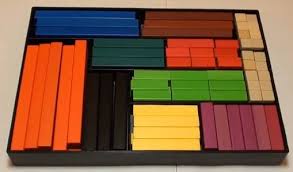
                                                                    Caleb Gattegno invented Cuisenaire rods and they became incredibly popular during the 50s and 60s.

His rods and teaching method truly changed the landscape forever in terms of teacher expectations of children’s maths understanding.

I was fortunate enough to have them introduced to me at an early stage of my career and to have been placed in a school where they were still widely used.
As a rather scared beginning teacher I followed the provided guide book to the letter and used them on a daily basis.
I quickly learned to revise my expectations of what my grade one students could do.
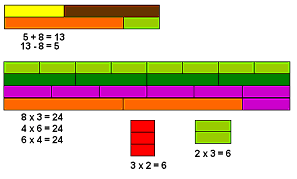
We went WAY beyond the curriculum requirements and my class easily added, subtracted, multiplied and used the division process.
They even learned fractions easily and naturally and set out to use rods to solve simple word problems.
They also used their rods to build structures and make pictures. Children loved them and they all had a set in their desks!

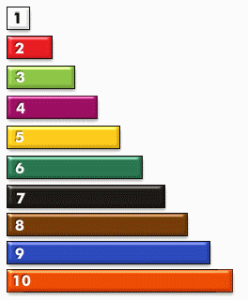
Each colour corresponded to a number and this aided fast retention.

Check out this addition lesson for an example of teaching addition to very young children.

https://www.youtube.com/watch?v=0vbpeKYH3z8

Sadly, the rods gradually went out of fashion and some experts commented that,

“Forever children will see YELLOW and think 5!”

Obviously they had not used Cuisenaire and certainly had not worked with kids! Kids are FAR smarter than that!

Some wise teachers continued using Cuisenaire to an extent and I am pleased to see them becoming popular again!

I now realise they can be used with older kids as well.
Teachers can demonstrate fractions, decimals, percentages with them, teach concepts of money, odd, even, factors and prime numbers and much more!
If they become widely adopted they will again show teachers how easy it is to teach kids to think mathematically and to develop fast recall and mastery of all major concepts.

Kids are much smarter than we think!

Of course they are but one resource in an ever-widening plethora of methods but it is one we can depend on to deliver results!

We have made them an integral part of our MAKING MATHS MEANINGFUL program and I hope to see them used again in all pre-schools and primary schools.

Children love these colourful manipulatives and as teachers and parents we all know what that means-

engaged kids+ great program= RESULTS!



The ABC of Child Whispering: Q is for QUICK

“Hurry. Get that done!”

“Quickly -don’t waste time!”

“Get a move on!”

“Just get it done!”

“No time for that. Move on!”

“Now! I said NOW!”

How often do we say similar words?

No wonder kids are spinning with no ability to stop, focus and slow down enough to try their hardest.

Why the need for this crazy pace?

Does speed add to the quality of life?

I doubt it!

We jerk our kids like puppets on strings and give them no time to play, reflect, think or daydream and them we act surprised when they show symptoms of ADHD! Then of course we often drug them.

Martin Whitely wrote an excellent book about this:

http://speedupsitstill.com/

I watch the new children at my centre work at a very fast pace and throw down their pencils, “Finished Vicky! What do I do next?”

I don’t have to tell them.

The regulars look up and answer patiently, “You daydream. It makes you smarter.” (This comes from a famous story from Einstein.)

We actually have to demonstrate HOW to daydream. Can you believe that? These kids have lost that ability!

Some years ago I told an EQ4KIDZ group of children in Singapore that they had all passed the course and could finish their workbooks at home in their spare time.

One child looked at me in a puzzled manner and asked, “What’s spare time?” He speaks English all the time and understands “spare” and “time” but has never seen or imagined how these concepts could be joined together!

It is NOT OK at keep treating our children in this way. Their lives do not need to be stuffed full of endless activities. They need more of the verb “To be.”

Let’s all put some empty spaces in our schedules this week- for ourselves and for our children.

Our minds, bodies and spirits will thank us.

Check out the link below for more ideas.

https://www.psychologytoday.com/blog/fixing-families/201101/the-frazzled-child-9-reasons-slow-down

What NAPLAN won’t measure


I have a lot of anxious kids at our centre this week.

One young lady told me she had not been to sleep properly for three nights because she was so worried about NAPLAN. We do our best to reassure kids that this is just a snap shot to help schools provide the best possible education but kids know the truth!

They know the letter will arrive.

They know they will be judged.

I watched the children intently yesterday as they chatted, grappled with maths problems and composed sentences and paragraphs. I listened to these children as they read their written maths aloud to help them comprehend the needed processes.

I watched a young man write a cohesive essay about the Stolen Generation and a year one child concentrate valiantly as she tried to get her letters to “bump up” against each other!

I was in awe as students compared a written text versus a filmed version of a fable. They were easily able to do this- even though there were quite young children in our class.

Our students continually inspire me. Sure- some of them have spelling and reading issues and quite a few seem to have an aversion to maths BUT there are so many elements involved in education and the important ones simply cannot be captured by NAPLAN.

e.g.

Kindness: the children showed great patience as a student attempted over and over to interrupt the teaching to avoid the inevitable writing that would follow! They certainly showed a much greater degree of patience than I did!

Creativity: One young student thought a writing task I had set was a little boring so his answer was all in rhyme- all six sentences!

Confidence: after telling a child that the way she had spelled a word was not the usual way, she looked at me in a kindly way, “Vicky this is the way I spell it!”

Persistence: One of our students came to us totally illiterate and yet yesterday could write 1.5 pages about herself and possible career paths within 5 minutes!

The children’s intelligence, persistence, creativity, resilience and confidence and kindness will never be measured in national testing and yet surely these are the most important qualities of all?


SURVIVING NAPLAN

Whether or not you agree with NAPLAN- it is arriving next week!

These tests are given to provide a snapshot of a student’s academic skills and the results help schools determine the effectiveness of their programs and the specific needs of their students.

Some children enjoy tests and many do not.

We have found many of our students are over-concerned and we know that stressed students are more likely to fail. This is the reason teachers and parents need to stay calm and help kids to de-stress.

Simply tell your child you know they will do their best and if they have problems you will help them and so will their school.

Don’t try to second-guess what might be in the test. It is far too late for that!

Now is the time for calm and focused thinking. Your children need good sleeps, minimum screen time and plenty of exercise.

Above all they need your calm attitude and a little fun! Laughter is excellent to lower stress levels and help children to stop worrying. No amount of worrying will help children to get better scores.

On the day of NAPLAN make sure your children eat a nutritious breakfast, get to school on-time and have a healthy packed snack and lunch.

They will probably want to chat to you about the tests after school but if not, just leave it be! They need a little down time to process and it is far better to simply continue with usual daily routines.

When you get the results, please do not stress if they are not what you expected. If your child gets nervous during tests they may make many mistakes and not really show what they can do.

Stay calm and congratulate them on pleasing results and tell children you will make sure they get all the help they need if the results are not good.

Remember-NAPLAN is just one measure of progress. Their teachers are also keeping dated samples of work, test results from class tests and observational records to make up a far more comprehensive picture.

Above all, help children to celebrate all their successes as well as difficulties and to let children know that their mistakes are simply signposts to success!


error

Enjoy this blog? Please spread the word :)